
Fixed-Price vs Time-and-Materials vs Dedicated Team: Which Software Contract Actually Protects You
The fixed price vs time and materials debate usually gets framed as a question of budget. It isn’t. It’s a question of who eats the cost when the plan changes — and on a custom software project, the plan always changes. Fixed-price contracts push scope risk onto the vendor; time-and-materials pushes it onto you; the dedicated team model splits it and hands you the steering wheel. Pick the wrong one and you’ll pay for it in change orders, padded estimates, or a build that technically matches the spec and still doesn’t work. This is the honest breakdown of who carries the risk in each model, where each one hides cost, and how disciplined shops actually contract — because it’s rarely one of the three in its textbook form.
We’ve delivered work under all three. Below is what we’d tell a friend, not what a sales deck says.
The three models, in one sentence each
A fixed-price contract sets one number for a defined scope. You agree what gets built, the vendor agrees what it costs, and the risk of estimating wrong sits with the vendor — in theory.
Time-and-materials (T&M) bills you for hours worked at agreed rates. Scope can flex; the meter runs; the risk of the project taking longer than hoped sits with you.
The dedicated team model is a subscription to capacity. You pay a monthly rate for a named team — say, three engineers, a designer, half a QA — and you direct their work like an in-house group you don’t have to hire. Risk is shared: they guarantee the people, you own the roadmap.
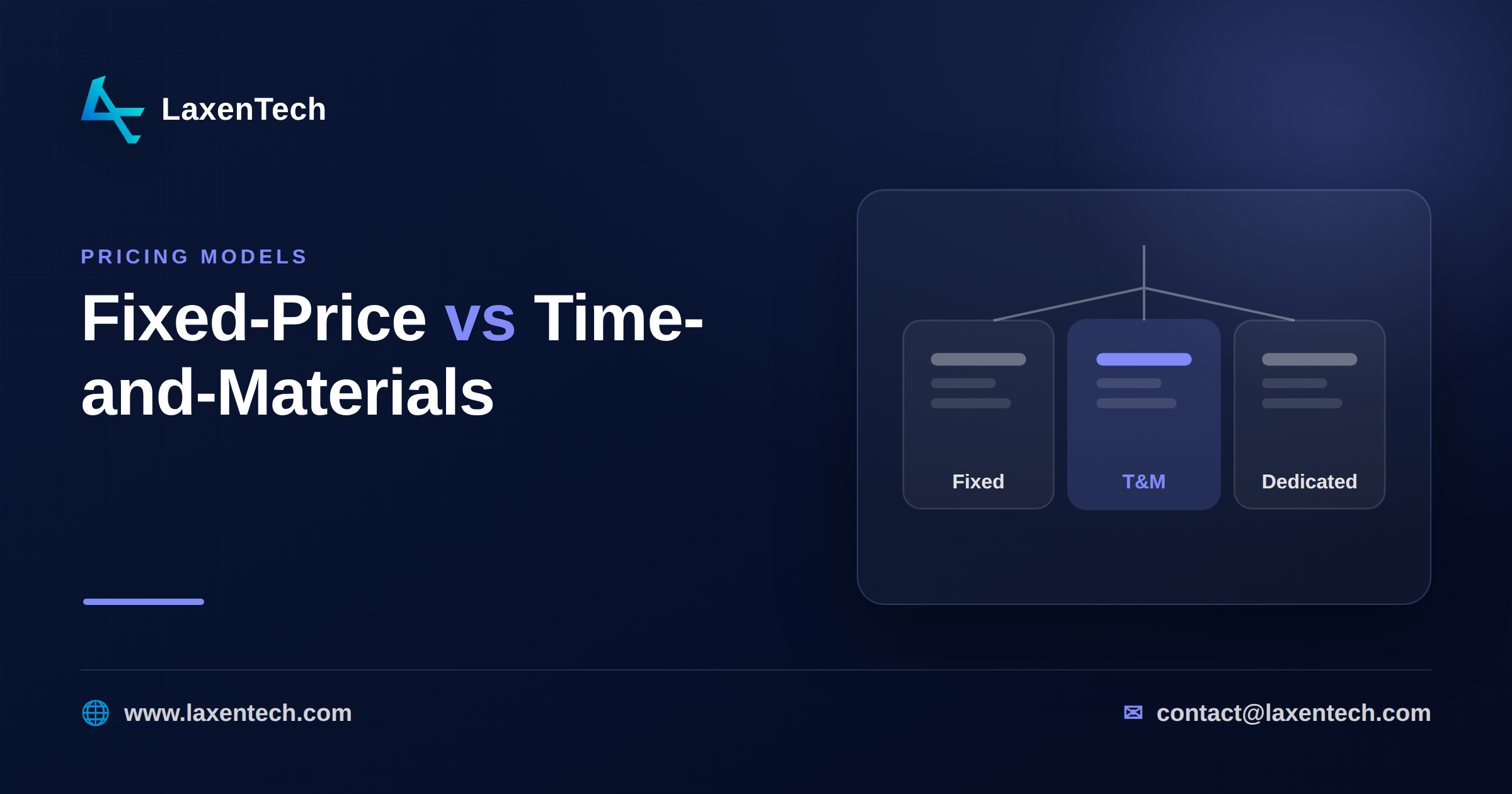
Three ways to buy the same engineering hours. The difference is entirely about who’s exposed when reality diverges from the estimate.
Who actually carries the risk
Vendors love to say fixed-price “de-risks” your project. Read that again. It de-risks the number — not the outcome.
Under fixed-price, a competent vendor prices in a buffer for everything that might go wrong. Industry padding runs 20–40% on top of the honest estimate, because the vendor is now insuring you against their own uncertainty. You pay that premium whether or not the risk materializes. And when your requirements shift — they will — you’re outside the contract, and every change becomes a negotiation where the vendor holds leverage, because switching mid-build is expensive and they know it.
Under T&M, you carry the schedule risk directly. If the work takes 900 hours instead of 700, you pay for 900. The upside: no padding, and you can change direction on a Tuesday without renegotiating a contract. The downside: a lazy or slow vendor has no financial reason to hurry, and a naive buyer with no oversight can watch a budget drift 60% over with nothing to point at.
The dedicated team splits it cleanly. The vendor guarantees availability and skill — if someone quits, replacing them is their problem and their cost. You guarantee direction — if you spend two sprints building the wrong feature, that’s on you. It’s the most honest allocation for ongoing product work, and the least forgiving of a buyer who doesn’t know what they want.
There’s no model where risk disappears. There’s only a choice about which risk you’re better equipped to carry.
Where each model hides its cost
Every pricing model has a cost that doesn’t show up on the invoice line you’re looking at.
Fixed-price hides cost in the change request. The base number looks clean and comparable — which is exactly why buyers love it and why it’s a trap. The real budget is base price plus change orders, and change orders are priced with zero competitive pressure. We’ve seen a ₹18 lakh fixed bid become ₹31 lakh by go-live, entirely through “that wasn’t in scope.” None of it was fraud. The scope was just incomplete on day one, as scopes always are.
T&M hides cost in the absence of a ceiling. Without a cap or a disciplined estimate, “we’ll bill as we go” can mean anything. The cost isn’t hidden in a clause — it’s hidden in the gap between the vendor’s incentive to finish and yours.
The dedicated team hides cost in idle capacity and ramp. You pay for the whole team every month, including the fortnight your product decisions weren’t ready and two engineers had thin backlogs. You also eat the ramp-up — the first three to six weeks where a new team is learning your domain and shipping slowly at full rate.
If a bid looks dramatically cheaper than the others, it’s not cheaper. The cost moved somewhere you’re not looking. Our longer take on this lives in our breakdown of what custom software actually costs.
The change-request reality nobody prices for
Here’s the thing that decides which model fits: how well-defined is the work, really?
If you can hand a vendor a spec so complete that a stranger could build it without asking you a question — a data migration, a document-processing pipeline, a well-understood integration — fixed-price is genuinely your friend. The scope won’t move because it can’t move; the requirements are external and fixed.
But most mid-market software isn’t like that. You’re building something because the off-the-shelf option didn’t fit, which means you’re partly discovering the requirements as you go. The moment your first users touch a working screen, they’ll tell you three things you got wrong. That feedback is the entire point of building custom — and under a fixed-price contract, acting on it costs extra, every time.
This is why fixed-price projects so often ship something that matches the document and misses the need. The contract rewarded conformance to a spec written before anyone knew enough to write it well. It’s a common thread in why software projects fail — the pricing model quietly punished the learning that the project depended on.
The honest hybrid most good shops actually use
Here’s what the textbook three-way choice leaves out: disciplined vendors rarely sell any of the three in pure form. The models that survive contact with real projects are hybrids.
Capped or estimated T&M
You bill by the hour, but with a not-to-exceed ceiling and a written estimate the vendor stands behind. You get T&M’s flexibility to change direction plus a fixed-price-style cap on your downside. The vendor can’t run the meter forever; you can’t be surprised at the end. If the estimate proves wrong, that’s a conversation before the cap, not a shock after it. This is our default for most mid-market builds, and it’s the one we’d recommend if you’re unsure.
Fixed-scope sprints
You buy work in two-week fixed-price increments. Each sprint has a defined, small, well-understood scope and a fixed cost. You re-plan at every boundary. It’s fixed-price protection at a granularity small enough that scope can’t rot — you’re never more than two weeks from a decision point, and you can stop whenever the value stops justifying the spend.
Discovery fixed, build flexible
A small, genuinely fixed-price discovery phase — two to four weeks — produces a real spec, a prototype, and a defensible estimate. Then you choose the delivery model with actual information. The discovery de-risks the estimate the rest of the contract depends on. Refusing to pay for discovery is how buyers end up trusting a fixed number that was a guess.
None of these are exotic. They’re what happens when a vendor optimizes for the project working instead of for the contract looking clean.
Fixed-price vs time-and-materials vs dedicated team: a plain comparison
Fixed-price | Time & materials | Dedicated team | |
|---|---|---|---|
Best for | Fully defined, stable scope | Evolving scope, active discovery | Ongoing product, long roadmap |
Who carries scope risk | Vendor (priced in) | You | Shared |
Flexibility to change | Low — every change is a negotiation | High | High |
Budget predictability | High on paper, weak in practice | Low without a cap | High per month, ongoing |
Vendor incentive | Finish fast, minimize their hours | Neutral without a cap | Retain you, ship steadily |
Hidden cost | Change orders | No ceiling | Idle capacity + ramp |
Overhead on you | Low during build, high at scope edges | Medium — needs oversight | High — you run the roadmap |
Read the “overhead on you” row twice. It’s the one buyers underweight. The dedicated team is powerful precisely because you direct it — which only works if you have someone who can direct it well.
How to choose: a short decision guide
Answer these honestly.
Is the scope genuinely fixed and fully known? If yes — a migration, a defined integration, a compliance report — take fixed-price and enjoy the predictability. If you’re hesitating, it isn’t fixed.
Is this a defined project with some unknowns, over a few months? Take capped T&M or fixed-scope sprints. You get flexibility with a floor under your risk. This covers most one-off builds.
Is this an ongoing product with a roadmap measured in quarters or years? Take a dedicated team — but only if you have a product owner who can feed it decisions. Without that person, you’re paying a full team to wait on you.
Do you not actually know the scope yet? Buy a fixed-price discovery, then decide. Don’t sign a delivery contract of any kind on a guess.
One more filter: how good is your own oversight? Fixed-price needs the least buyer discipline during the build. Dedicated teams need the most. Match the model to the attention you can genuinely give it, not the attention you wish you had. If you’re weighing this alongside vendor selection, our guide on how to choose a software development company covers the questions that expose how a shop really operates.
When each model is the wrong choice
Fixed-price is wrong when your requirements are still forming — you’ll pay a padding premium and fight over every change. It’s also wrong when you’re comparing bids purely on the base number, because you’re comparing the parts of the price that lie.
T&M is wrong when you have no capacity to review work weekly. Uncapped T&M with an absent buyer and an unmotivated vendor is the worst outcome in this entire post — there’s nothing structural stopping the drift.
The dedicated team is wrong when you have a short, bounded project, or when nobody on your side can own the roadmap. You’ll pay for capacity you can’t direct, and blame the team for building the wrong thing you didn’t stop them from building.
There’s no universally correct model. There’s a correct match between the model, the work, and how much attention you can actually spare.
How LaxenTech helps
We don’t lead with a pricing model — we lead with figuring out which one protects you. Our IT consulting engagements start by pinning down how defined your scope actually is, then recommend the structure that fits: a genuine fixed-price where the scope justifies it, capped T&M or fixed-scope sprints where discovery is still live, or a dedicated team where you’ve got a real roadmap and someone to steer it.
When the work is a build, our custom software and web development teams deliver under whichever structure we agreed — with written estimates, sprint-boundary check-ins, and change handling defined before the first line of code, not improvised when scope shifts. If you already run one of our products — the ERP Management System, Social Media Management System, or PDF Enhancer — customization work slots into the same transparent model.
The goal is the same regardless of which contract you sign: no surprises at go-live.
Frequently asked questions
Is fixed-price or time-and-materials cheaper?
Neither is reliably cheaper. Fixed-price adds a 20–40% risk premium up front but caps your exposure to a defined scope. T&M removes the premium but exposes you to overruns. For fully known work, fixed-price often wins on total cost; for evolving work, capped T&M usually costs less because you’re not paying for padding you don’t need.
What is the dedicated team model best suited for?
Ongoing product development with a roadmap measured in quarters — a startup building a platform, or a mid-market firm running continuous improvement on internal systems. It works when you have someone to direct the team daily. For a single bounded project with a clear end, fixed-price or capped T&M fits better and costs less.
How do change requests work under a fixed-price contract?
Anything outside the original spec becomes a change order, priced and approved separately — usually with no competitive pressure, since switching vendors mid-build is costly. This is the model’s biggest hidden expense. Before signing, ask exactly how changes are priced and how “in scope” gets decided. Vague answers there predict friction later.
What is capped time-and-materials?
You bill hourly, but with a not-to-exceed ceiling and a written estimate the vendor commits to. It combines T&M’s flexibility to change direction with fixed-price’s protection against runaway cost. If the work approaches the cap, that’s a conversation before you hit it — not a surprise afterward. It’s a sensible default for most mid-market builds.
Which contract type is safest for a first-time buyer?
Fixed-scope sprints or capped T&M with weekly reviews. Both give you decision points every couple of weeks and a spending floor, so a first-time buyer can’t drift far before catching a problem. Avoid uncapped T&M until you’ve built the oversight habit, and avoid large fixed-price contracts on scope you can’t fully define yet.
Should I pay for a discovery phase before choosing a model?
Usually yes. A short fixed-price discovery — two to four weeks — produces a real spec, a prototype, and a defensible estimate, so you choose your delivery model with information instead of a guess. It feels like an extra cost, but it’s what makes every downstream number trustworthy. Skipping it is how buyers end up trusting a guess.
The model that protects you is the one matched to how defined your scope is and how much oversight you can give it — not the one with the cleanest-looking number. Fixed-price for known work, capped T&M or sprints for the common in-between, a dedicated team for the long haul. Most real projects land on a hybrid, and that’s a sign of discipline, not indecision.
Not sure which fits your project? Tell us what you’re building and we’ll recommend the structure that actually protects you — even when that’s not the biggest contract for us.
LaxenTech Engineering
The engineering team at LaxenTech — building custom software, systems integration and AI-driven solutions.
Related posts
HIPAA-Compliant Software Development: A Practical Guide
A practical HIPAA compliance guide for healthcare software — access controls, encryption, BAAs and the mistakes that fail audits. Design it in from day one.
Fintech Software Development: Cost, Compliance & Process
Fintech software development explained — PCI DSS and SOC 2 compliance, secure architecture, and what a compliant build really costs and takes.
How to Build a Custom AI Chatbot for Your Business
How to build a custom AI chatbot for your business — RAG explained simply, build vs buy, guardrails against hallucination, and realistic cost and ROI.