
IT staff augmentation vs project outsourcing vs in-house: which model fits
Pick staff augmentation when you have a plan and a team but not enough hands. Pick project outsourcing when you need a result and don’t want to manage the how. Keep it in-house when the software is the thing you sell, or so tied to your business that owning the knowledge matters more than speed. Most of the confusion in the staff augmentation vs outsourcing debate comes from treating them as the same purchase. They’re not. One buys you capacity inside your own process; the other buys you an outcome and a process you rent.
The mistake I see most often: a team picks the model that’s cheapest on paper, then spends the savings on coordination overhead nobody budgeted for. So before comparing rate cards, get clear on what you’re actually buying.
The three models in plain terms
Here’s the shortest honest version of each.
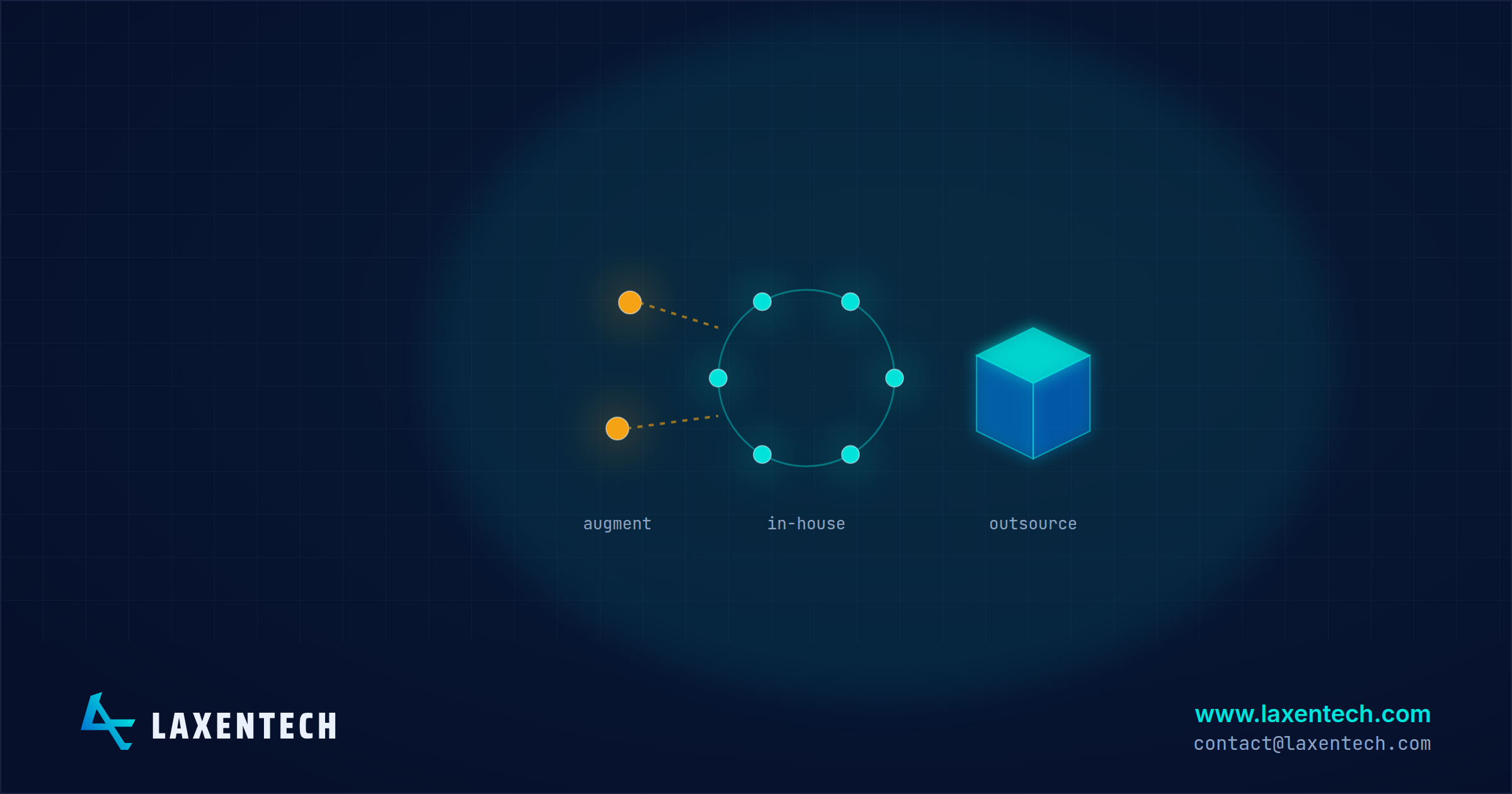
IT staff augmentation means you bring in outside engineers who work as part of your team. They join your standups, use your tools, follow your process, and report into your managers. You still own the roadmap, the architecture decisions, and the definition of done. You’re renting skills and capacity, not handing off responsibility. A dedicated development team is the longer-term version of this, where the same people stay with you for months and build real context.
Project outsourcing means you hand a defined scope to a vendor and they deliver it. They bring their own project manager, their own process, their own team, and usually their own estimate. You define the what and the acceptance criteria; they own the how and the day-to-day. You’re buying an outcome. If you’ve read up on fixed-price vs time-and-materials contracts, this is the model where that choice matters most, because outsourcing lives or dies on how the scope and the money are structured.
In-house means you hire employees. They’re on payroll, they’re yours, and the knowledge stays in the building. Highest commitment, highest control, slowest to spin up, hardest to spin down.
That last point is the quiet truth behind all three. The real trade you’re making is between control and commitment on one side, and speed and flexibility on the other.
Cost, control and risk compared
Rate is the easiest number to compare and the least useful on its own. A cheaper hourly rate that needs three times the management is not cheaper. Here’s how the three models actually stack up on the factors that decide your total cost.
Factor | Staff augmentation | Project outsourcing | In-house |
|---|---|---|---|
Who owns the roadmap | You | Shared, mostly the vendor | You |
Management overhead on your side | Medium to high | Low | High |
Speed to start | Fast (days to weeks) | Medium (scoping first) | Slow (hiring cycle) |
Speed to stop | Fast | Ends with the project | Slow, and costly |
Cost predictability | Time-based, variable | Can be fixed if scope is clear | Fixed salary, plus overhead |
Where knowledge lives | Partly with you | Mostly with the vendor | Fully with you |
Best for | Known plan, short of hands | Defined outcome, outsourced delivery | Core product, long horizon |
Biggest risk | You still have to manage them well | Scope gaps and handoff loss | Slow to build, hard to unwind |
A few things worth calling out.
Staff augmentation looks flexible, and it is, but it moves the management burden onto you. If your team can’t give clear direction, adding contractors just adds people waiting for direction. Outsourcing flips that: low overhead for you, but you lose visibility, and anything the vendor learned about your systems tends to walk out the door when the contract ends. In-house is the most expensive per head once you count recruiting, benefits, tooling and the months before a new hire is productive, but for the systems your business runs on, that cost buys you something the other two can’t.
If you’re trying to model the numbers properly rather than eyeball a rate, our breakdown of what custom software development actually costs walks through the line items people usually forget.
When staff augmentation is the right call
Staff augmentation fits when you already know what to build and how you want it built, and the only gap is capacity or a specific skill.
Concrete cases where it works well:
You have a deadline and your team is one or two engineers short of making it.
You need a niche skill for a while but not forever. Think a data engineer for a six-month migration, or someone who actually knows Kubernetes before you commit to it in production.
You want to scale a team up for a heavy quarter and back down after, without hiring and then laying people off.
Your architecture and standards are solid, so a good engineer can plug in and be useful in a week.
The thing that makes or breaks it is your own process. Augmented engineers inherit your discipline. If your code review is thin, your tickets are vague, and onboarding is a Slack message and good luck, contractors will be as unproductive as that setup makes everyone. When NOT to use it: if you don’t have the senior people to direct the work and review it, you’re not buying capacity, you’re buying risk. In that situation outsourcing the whole thing is usually safer.
When to outsource a whole project
Outsource when you need a defined outcome, the work sits outside your core focus, and you’d rather manage a deliverable than a team.
Good candidates:
A self-contained build with a clear boundary. A customer portal, an internal tool, a mobile app that talks to your existing API.
A one-time modernization or migration where the vendor has done it a dozen times and your team has done it zero.
Work your in-house engineers shouldn’t be pulled onto because their attention belongs on the core product.
The risk with outsourcing is almost always scope. Everything the contract names goes fine. The trouble is the gaps between the lines, the assumptions nobody wrote down, the integration that turned out to be three integrations. Two things protect you: a genuinely detailed scope, and a vendor who ships working software often enough that you can course-correct early instead of discovering the miss at the end.
When NOT to outsource: anything that changes weekly, or anything so central to your business that losing the institutional knowledge would hurt. Handing off a fuzzy, fast-moving problem to a fixed-scope contract is how you end up paying for change requests every second week. And if you’re still deciding who to trust with it, our guide on how to choose a software development company covers the questions that actually predict how a partnership will go.
When to keep it in-house
Keep it in-house when the software is a source of competitive advantage, or when it’s so woven into how you operate that the knowledge has to stay with you.
Your core product is the obvious one. If software is what customers pay for, the people who build it shouldn’t be renting desks. There’s a second, less obvious case: systems that don’t ship to customers but run the business. The pricing engine, the logic that routes work across your operation, the model nobody outside your walls understands. That kind of knowledge is expensive to rebuild and dangerous to lose.
In-house isn’t free of downsides. Hiring is slow, good engineers are hard to find, and a team sized for your busiest quarter sits idle in the quiet ones. That’s exactly why plenty of companies run a hybrid: a small in-house core that owns the crown-jewel systems, augmented with outside engineers when the load spikes, and the occasional whole project handed to a partner. You don’t have to pick one model for the whole company. Pick per workstream. This is the same in-house vs outsourcing software question most teams eventually answer with “both, in different places.”
A 6-question model-selection scorecard
When you’re stuck between models, answer these six. They cut through most of the noise.
Do we know exactly what to build? Yes and detailed points to outsourcing. Yes but it’ll shift weekly points to augmentation or in-house.
Do we have senior people to direct and review the work? No pushes you toward outsourcing, where the vendor brings that layer. Yes keeps augmentation and in-house open.
How long is the need? Weeks to a few months favors augmentation or a project. Years favors in-house.
Is this our core product or a source of advantage? If yes, lean in-house and be cautious about handing it off.
How much do we care where the knowledge ends up? If it has to stay with us, that argues for in-house or long-running augmentation over a hand-off.
Can we manage another team day to day? If your managers are already stretched, outsourcing’s lower overhead is worth real money.
No single answer decides it. But if you’re leaning outsource on questions one and two and in-house on four and five, that’s a signal to split the work rather than force one model onto all of it.
How LaxenTech structures engagements
We run engagements the same way whichever model you pick, because the discipline is what protects the outcome. Every project starts with Discover, where we map the process, interview the people who actually use the system, and document the integrations before anyone writes code. Then Architect (system design, data model, tech stack, deploy plan), then Build in two-week sprints with a working demo at the end of each one, then Ship with a zero-downtime deploy and hypercare after go-live. Every pull request gets reviewed, whether the author is on our team or yours.
That structure is what lets us flex the commercial model to fit your situation instead of the other way around. Some clients bring us in as a dedicated development team alongside their own engineers; others hand us a whole build. Our IT consulting and engagement services exist for exactly the case where you’re not sure which of those is right yet, and want to reason it through with people who’ve shipped both. We’re an engineering-first firm working with clients across roughly twelve countries in logistics, healthcare, energy and financial services, and the model conversation always comes before the code.
Frequently asked questions
What’s the main difference between staff augmentation and project outsourcing?
Staff augmentation adds people to your team who work under your management and process; you keep ownership of the roadmap and the how. Project outsourcing hands a defined scope to a vendor who manages delivery and gives you back a result. One buys capacity, the other buys an outcome.
Is staff augmentation cheaper than hiring in-house?
Per hour, often yes, and you skip recruiting time and long-term commitment. Over several years for a permanent need, in-house usually wins on cost because you’re not paying a margin indefinitely. Augmentation is cheaper for variable or short-term demand, not as a permanent substitute for a role you’ll always need.
Can I switch models partway through a project?
Yes, and it’s common. A frequent path is to outsource an initial build, then move to augmentation or an in-house team to maintain and extend it once the knowledge is transferred. The key is planning the handoff early so documentation and context come with it, rather than treating the transition as an afterthought.
How do I keep control when I outsource a project?
Insist on short delivery cycles with a working demo you can actually use, a detailed scope with named acceptance criteria, and named people you can talk to directly. If a vendor only shows you finished work at the very end, that’s a warning sign. Regular, inspectable progress is your main lever of control.
Does a dedicated development team count as staff augmentation or outsourcing?
It sits in between and leans toward augmentation. A dedicated team is a stable group that works with you over months, learns your systems, and integrates with your process, rather than delivering one fixed-scope project and leaving. You get continuity closer to in-house without the permanent headcount.
When does in-house genuinely make more sense than either alternative?
When the software is your product or a real competitive edge, when the domain knowledge must stay in the company, or when the work is continuous and central enough that a permanent team pays for itself. For anything peripheral, short-term, or clearly bounded, augmentation or outsourcing is usually the better use of money.
What if I’m not sure which model fits my roadmap?
That’s normal, especially when different parts of the roadmap point to different answers. Map each major workstream against the six-question scorecard above rather than choosing one model for everything. Talk to us about the right engagement model for your roadmap — no commitment. Reach out through our contact page and we’ll reason through it with you.
LaxenTech Engineering
The engineering team at LaxenTech — building custom software, systems integration and AI-driven solutions.
Related posts
HIPAA-Compliant Software Development: A Practical Guide
A practical HIPAA compliance guide for healthcare software — access controls, encryption, BAAs and the mistakes that fail audits. Design it in from day one.
Fintech Software Development: Cost, Compliance & Process
Fintech software development explained — PCI DSS and SOC 2 compliance, secure architecture, and what a compliant build really costs and takes.
How to Build a Custom AI Chatbot for Your Business
How to build a custom AI chatbot for your business — RAG explained simply, build vs buy, guardrails against hallucination, and realistic cost and ROI.