
Legacy system modernization: strategies, costs and a migration roadmap
Modernize a legacy system by picking the least invasive change that fixes your actual problem, then moving one module at a time instead of rewriting everything at once. Most failed migrations fail for one of two reasons: a team chose a full rebuild when a rehost or targeted refactor would have done the job, or they attempted a big-bang cutover with nowhere to fall back to when it broke. The decision that matters isn’t “cloud or not.” It’s which of six approaches fits each part of your estate, and in what order you touch them.
This guide gives you a real decision matrix, a phased roadmap that avoids the big-bang trap, and a straight answer on what drives cost and where projects quietly die.
What legacy modernization actually means
A legacy system isn’t just old. It’s a system that resists change, where a small feature request takes weeks, the people who understood it have left, and the risk of touching it outweighs the value of improving it. Age is a symptom, not the diagnosis.
Application modernization is the work of reducing that resistance: moving off unsupported runtimes, breaking a tangled monolith into independently deployable pieces, replacing brittle point-to-point integrations, or lifting a stable workload onto infrastructure you can still buy support for. Sometimes it’s a rewrite. Often it isn’t.
The signals it’s time:
Vendor support or the underlying platform has hit end-of-life, and security patches have stopped.
Change velocity has collapsed. Every release needs a full regression cycle because nobody trusts the blast radius.
You can’t hire for the stack anymore, or you’re paying a premium to keep two contractors who alone understand it.
Compliance or audit requirements the system was never built to meet are now mandatory.
Cloud or integration costs are ballooning because the architecture fights every attempt to scale a single component.
If none of those bite, you may not have a modernization problem yet. More on that below.
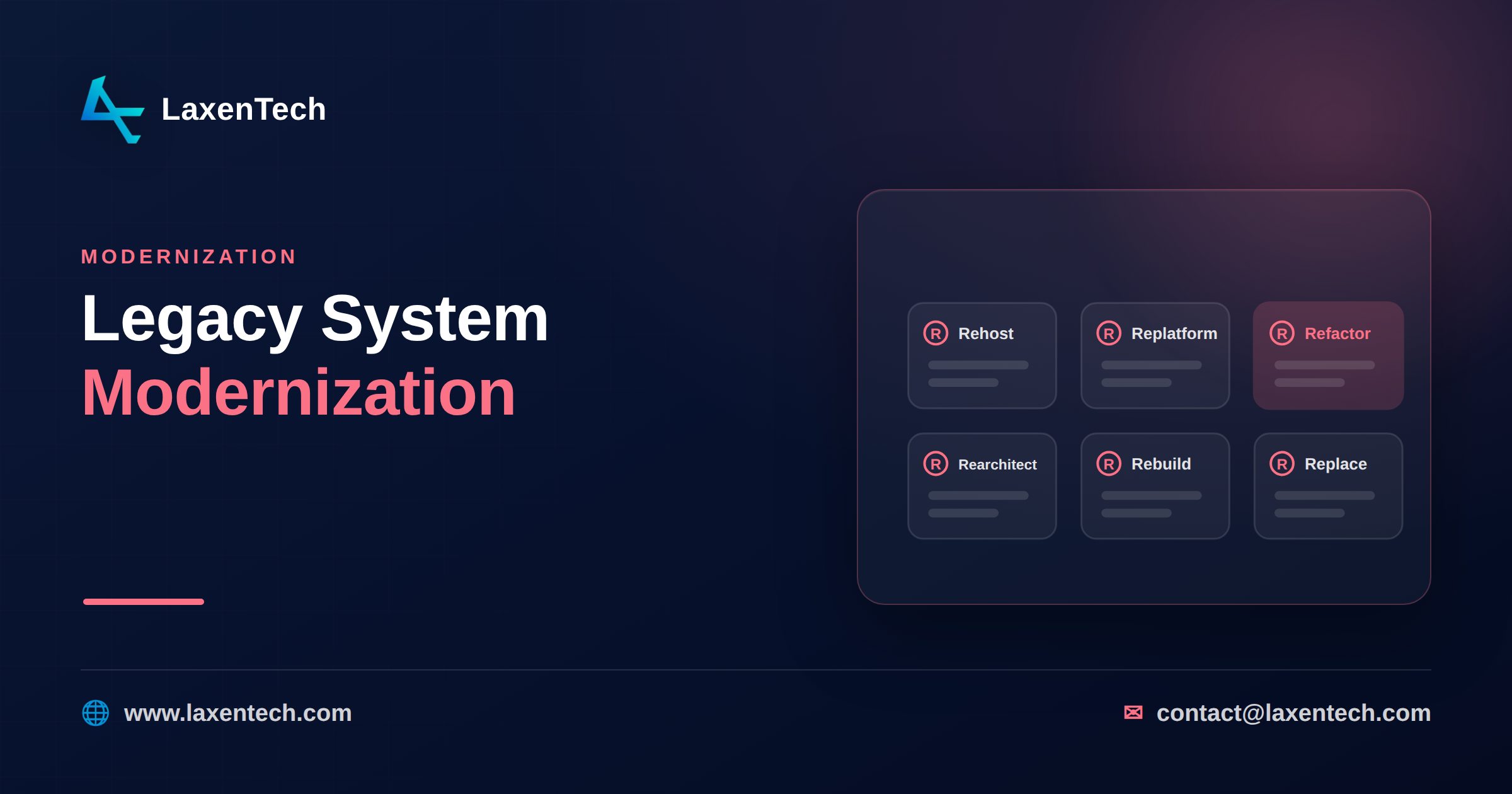
The 6 R’s: a decision matrix
Every workload gets sorted into one of six treatments. The trap is applying one strategy across the whole estate. A CTO’s job here is triage: map each system to the cheapest option that actually solves its problem.
Approach | Best for | Risk | Relative cost | Pick it when |
|---|---|---|---|---|
Rehost (lift-and-shift) | Stable apps you just need off dying hardware or a data center | Low | Low | The code is fine; the infrastructure is the problem. Fast win, no architectural gain. |
Replatform | Apps that benefit from managed services (DB, runtime) without code surgery | Low–medium | Low–medium | You want managed databases or containers but the app logic is sound. |
Refactor | A monolith whose internals are messy but whose boundaries are roughly right | Medium | Medium | Change velocity is the pain and you can improve it in place, incrementally. |
Rearchitect | Systems that must scale components independently or move to services | Medium–high | High | Coupling is the ceiling — you need to split the monolith to grow. |
Rebuild | Core systems where the domain is understood but the implementation is a dead end | High | High | Rewriting is genuinely cheaper long-term than maintaining the current code. |
Replace | Commodity capability (CRM, HR, ticketing) a SaaS product covers | Medium | Varies | You’re maintaining custom code for a problem the market already solved. |
Two notes from experience. Replatforming vs refactoring is the most common tie to break: replatform when the infrastructure is the cost, refactor when the code is the cost. They’re not interchangeable, and doing both at once triples your variables. And rebuild is where budgets go to die; treat it as the last resort, chosen deliberately, never by default because the old code is ugly.
A phased roadmap that avoids big-bang cutover
The strangler fig pattern is the safe path for anything mission-critical. You grow the new system around the old one, route traffic across piece by piece, and let the legacy system shrink until there’s nothing left to switch off. No single terrifying weekend where everything moves at once.
Assess and prioritize. Inventory every system, its dependencies, and its integration points. Rank by risk and business value. Start where value is high and coupling is low — you want an early, visible win that builds trust.
Wrap with APIs. Put a clean interface in front of the legacy system so new components can talk to it without knowing its internals. This is the seam the whole migration hangs on.
Migrate module by module. Rebuild or replatform one bounded capability, point the API facade at the new implementation, and leave the rest untouched. Repeat.
Run in parallel. Keep old and new live together. Shadow traffic, compare outputs, reconcile data. This is where you catch the differences no spec captured — and where a phased approach earns its cost, because you can roll a single module back without a full restore.
Decommission. Once a module is proven in production and the legacy path is dark, retire it. The old system dies in slices, not in one leap.
Data migration is the part everyone underestimates. Schema drift, undocumented business rules baked into stored procedures, records that violate the constraints your new model assumes: plan for weeks of reconciliation, not a scripted overnight load.
Cost and risk reality
What drives the cost of legacy system modernization isn’t the new code. It’s the archaeology: understanding a system nobody documented, untangling integrations, migrating dirty data, and running two systems in parallel while you cut over. The build is often the cheapest line item.
Where projects fail:
Scope creep into a rewrite. A refactor quietly becomes a rebuild because the team keeps finding reasons to “do it properly.” Set the treatment per module and defend it.
No rollback. Big-bang cutovers with no parallel-run leave you exposed. Phasing is insurance.
Underestimated data work. Teams budget for application logic and forget the data has thirty years of exceptions in it.
Losing the domain knowledge. The behavior that matters most is often the undocumented edge case. Talk to the people who run the system before you touch it.
De-risk by keeping changes small and reversible, running in parallel, and refusing to modernize and re-scope features in the same pass. Freeze the requirements to “match today’s behavior” first; improve after you’ve landed.
When not to modernize
Sometimes the right call is to leave a system alone. If it’s stable, cheap to run, fully understood, and not blocking anything, modernizing it spends budget to buy risk. A system at end-of-life with no security exposure and no change demand can sit untouched for years. “It’s old” is not a business case. Modernize when the cost of the status quo (risk, drag on the roadmap, an unhireable stack) exceeds the cost and risk of change. Until then, wrap it, monitor it, and spend the money where it moves the business.
How LaxenTech approaches it
This is the work LaxenTech is built for. Our delivery mirrors the roadmap above: we Discover, mapping your process and documenting every integration point before proposing a treatment; then Architect the target system and data model, Build in two-week sprints with a working demo each cycle, and Ship with zero-downtime cutover, monitoring, and hypercare. That means module-by-module migration with a demo you can pressure-test, not a plan you approve on faith. If you’re weighing IT consulting or system design support for a migration, that’s where a conversation starts.
Frequently asked questions
What is legacy system modernization?
It’s the work of reducing a system’s resistance to change: moving off unsupported platforms, restructuring tangled code, replacing brittle integrations, or migrating stable workloads to supportable infrastructure. The goal is lower risk and higher change velocity, not newness for its own sake.
What’s the difference between replatforming and refactoring?
Replatforming moves an app to better infrastructure (managed databases, containers) with little or no code change; pick it when the infrastructure is your cost. Refactoring restructures the code itself to improve maintainability; pick it when the code is your cost. Doing both at once multiplies risk.
How do you modernize a legacy monolith without a big-bang rewrite?
Use the strangler fig pattern: wrap the monolith in an API layer, then rebuild or replatform one bounded capability at a time behind that facade, running old and new in parallel until each slice is proven. The legacy system shrinks module by module and is decommissioned last.
What does legacy system modernization cost?
Cost is driven less by writing new code than by understanding the old system, untangling integrations, migrating dirty data, and running parallel systems during cutover. A realistic estimate comes from an assessment of your estate, not a price list.
What are the 6 R’s of modernization?
Rehost, replatform, refactor, rearchitect, rebuild, and replace. Each maps to a different combination of system type, risk, and cost, so you sort each workload into the cheapest treatment that solves its problem rather than applying one strategy everywhere.
When should you not modernize a system?
When it’s stable, cheap to run, understood, secure, and not blocking your roadmap. Age alone isn’t a reason. If the cost of the status quo doesn’t exceed the cost and risk of change, wrap it, monitor it, and invest elsewhere.
Legacy modernization succeeds when you stop treating it as one big project and start treating it as a sequence of small, reversible decisions — the right R for each workload, one module migrated at a time, old and new running side by side until the switch is boring. Match the strategy to the problem, protect a rollback path, and respect the data. If you’re mapping a migration and want a partner who’ll document the hard parts before proposing a plan, talk to LaxenTech.
LaxenTech Engineering
The engineering team at LaxenTech — building custom software, systems integration and AI-driven solutions.
Related posts
HIPAA-Compliant Software Development: A Practical Guide
A practical HIPAA compliance guide for healthcare software — access controls, encryption, BAAs and the mistakes that fail audits. Design it in from day one.
Fintech Software Development: Cost, Compliance & Process
Fintech software development explained — PCI DSS and SOC 2 compliance, secure architecture, and what a compliant build really costs and takes.
How to Build a Custom AI Chatbot for Your Business
How to build a custom AI chatbot for your business — RAG explained simply, build vs buy, guardrails against hallucination, and realistic cost and ROI.